The short answer
Yes, if anything more than most: male skin produces up to four times the oil of female skin and carries roughly a quarter more collagen. A men's facial is not a different treatment, just the same one, read for that skin.
Short answer: probably, and arguably a bit more than most people assume. Male skin runs oilier and thicker than female skin on average, on top of the daily wear and tear of shaving, so there is a real, physical case for it, not just a marketing one. A men’s facial is not some separate, secretive treatment either. It is the same cleanse, exfoliate, extract, mask and moisturise routine as any facial, just read for the skin in front of the therapist. Here is what that actually looks like, why male skin behaves differently in the first place, and when we would honestly say skip it.
What actually happens in a men’s facial
Strip away the branding and every facial, men’s or otherwise, follows the same shape: a cleanse, an exfoliation, extraction if your pores need it, a mask suited to your skin, then moisturiser to finish. That is confirmed by looking at how established grooming brands actually run it: Truefitt & Hill’s London facial treatment walks through “exfoliation, cleansing, the extraction of comedones, toning, the application of a mask, moisturising, a massage,” and ESPA’s men’s deep-cleansing facial is built around a “triple cleanse, exfoliation, steam and extraction, facial massage, personalised mask.”
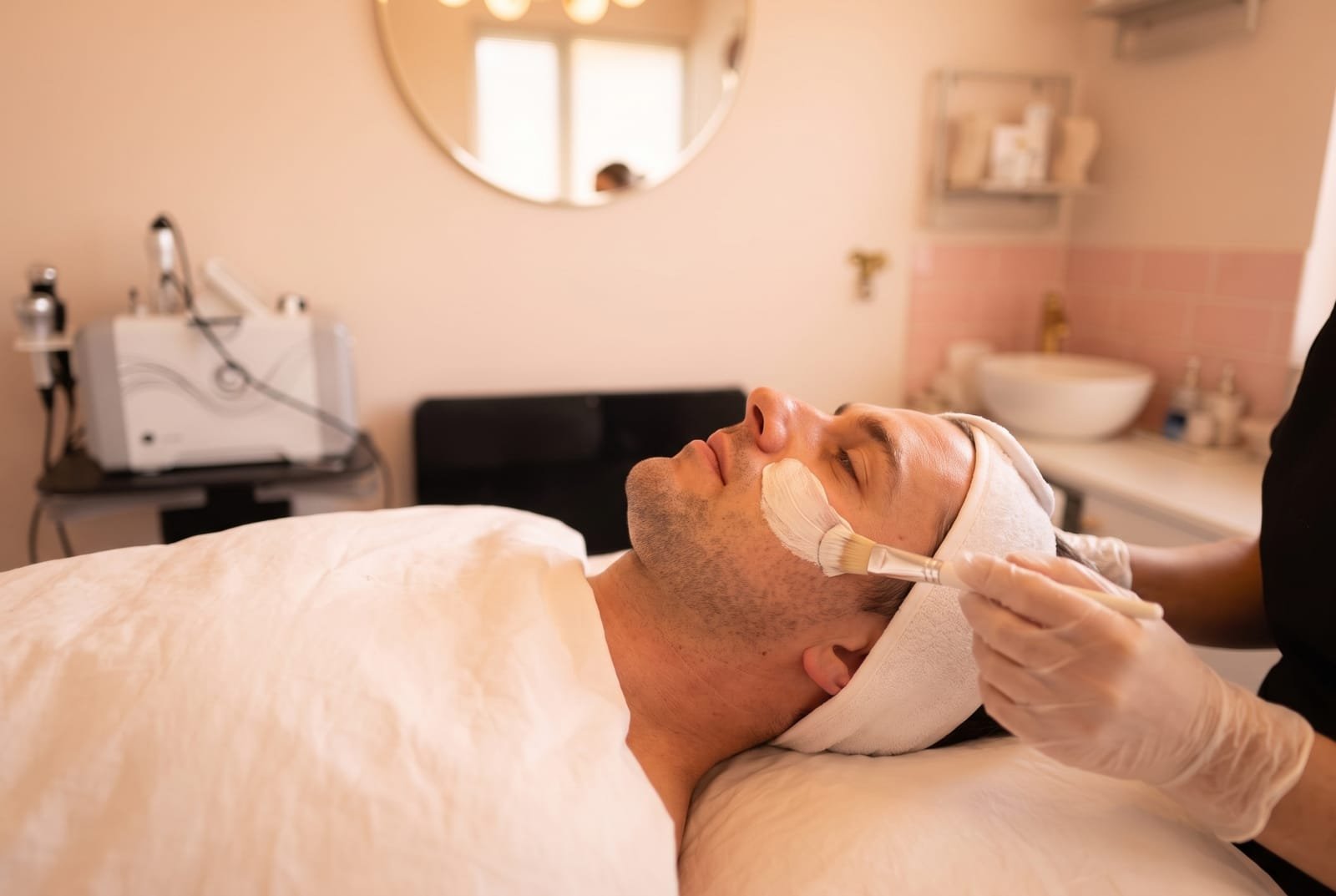
So picture a first visit. You come in with skin that is a bit shiny by mid-afternoon and a couple of blocked pores across the nose that will not shift no matter how hard you scrub. The therapist starts with a proper cleanse, has a look at your skin under good light, then works through a gentle exfoliation to lift the dull surface layer. If there is real congestion, extraction comes next, careful and controlled rather than the squeeze-and-hope approach most of us default to at home. A mask goes on to calm and balance things while you lie there for ten minutes doing nothing, which is honestly most of the appeal. It finishes with a proper moisturiser and, in daylight hours, SPF. Nothing about it needs a beard trimmed off first or a special outfit; you turn up as you are.
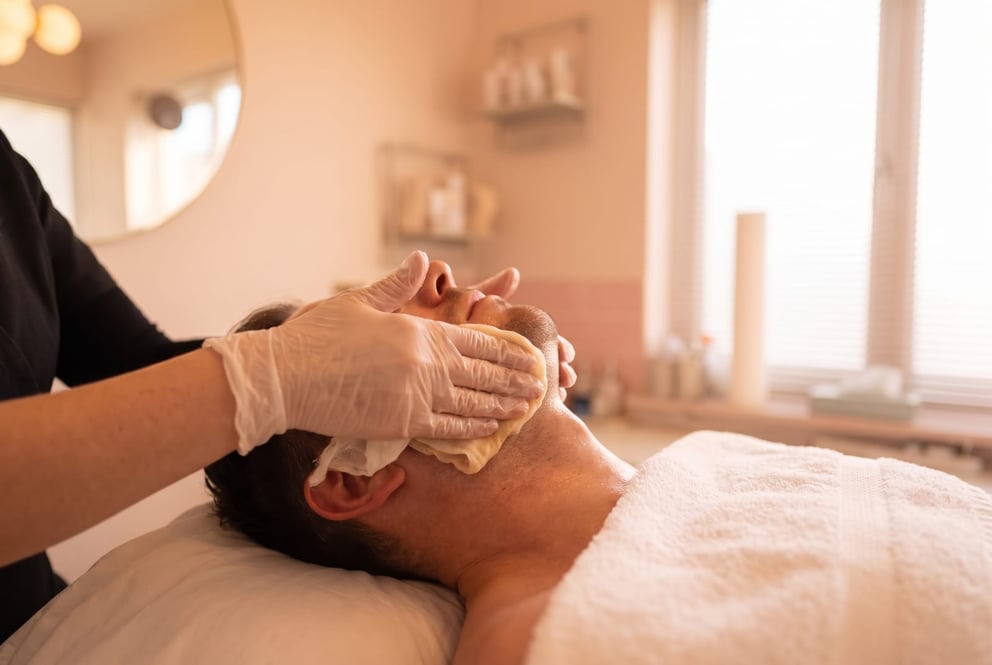
At our Haverhill salon that starting point is a straightforward £40 facial cleanse, or an £69.30 extraction facial if congestion is the main complaint. Either sits on our advanced facials menu alongside gentler options like an Elemis facial for something more relaxing than results-driven.
Why male skin behaves differently
There is a real, physical reason a facial can pull double duty for men, and it comes down to skin biology rather than preference. Testosterone drives sebaceous gland activity harder in men than women, and studies measuring sebum output in vivo put men at around 3mg/cm² of facial oil against roughly 0.7mg/cm² in women, close to a four-fold difference, according to a peer-reviewed review of skin-physiology research covering more than fifty underlying studies. The same review reports male skin carries up to around 25% greater collagen density than female skin, which is part of why male skin also tends to thin later and more gradually with age rather than dropping sharply, the way female skin often does after the menopause.
Male skin produces roughly four times the surface oil of female skin and carries around a quarter more collagen. That is not vanity talking; it is simple biology, and it is why a facial does a genuinely different job on male skin than it does on female skin.
Practically, that oilier, thicker skin congests faster, which is exactly the kind of build-up a cleanse-and-extract facial is built to clear. It is also part of why male skin can look like it is “ageing better” for longer, then catch up more suddenly once collagen loss does kick in, which is one more reason regular upkeep rather than a single rescue visit tends to pay off.
Do men have to shave before a facial?
No, and if anything most therapists would rather you did not. A fresh, close shave right before a facial leaves the skin already irritated, which makes cleansing and extraction sting more than they need to. London men’s facial pages back this up directly: one clinic’s signature men’s facial is explicitly designed to work “beneath the beard (no need to clean shave beforehand),” clearing congestion around and under facial hair rather than requiring it gone first, and Mansculpt Clinic makes the same point, describing its therapists as “used to working with all kinds of facial hair” so the skin underneath still gets the benefit.
If you shave daily, that habit is worth a mention too. The American Academy of Dermatology’s guidance on preventing razor bumps and ingrown hairs (shave with the grain, soften hair first with a warm compress, use a non-comedogenic cleanser and moisturising shaving product, change blades every five to seven uses) is exactly the sort of thing a therapist can check and reinforce during a facial, since shaving irritation and ingrown hairs are one of the most common things that bring men in. If ingrown hairs are more of a body issue for you, our guide to getting rid of ingrown hairs covers the same principles for waxed areas.
Who a facial genuinely is not for
A facial is cosmetic skincare, not a medical treatment, and it is worth being honest about where that line sits. Persistent cystic acne, diagnosed rosacea, or a mole or lesion that has changed shape or colour are all things for a GP or dermatologist, not a beauty salon, and a good therapist will say so rather than treat around it. Results from a single session are real, particularly the immediate clarity and calm, but established pigmentation or deep scarring genuinely need a course of treatments rather than one visit to make a real dent, which several clinics are upfront about rather than overselling a first appointment.
The full honest option set
A facial is one route to better skin, not the only one, so here is where it sits against the alternatives, including the ones we do not sell.
| Route | What it actually is | Best for |
|---|---|---|
| A basic home routine | Cleanser, moisturiser, sunscreen, done daily | The baseline everyone should have, cheapest option, works for most everyday skin |
| Off-the-shelf men’s kits | Bundled cleanser/moisturiser/serum sets from grooming brands | A step up from nothing, no appointment needed, results depend on consistency |
| A standard salon facial | Cleanse, exfoliate, extract, mask, moisturise, by hand | General upkeep, congestion, dullness, a proper professional look at your skin |
| An advanced facial | Dermaplaning, microneedling, peels, LED, more targeted and intense | Visible results on texture, scarring or pigmentation, usually as a course |
| A specialist men’s clinic | Dedicated grooming clinics with their own “men’s facial” branding | Those who want a male-only environment; we do not offer this, we welcome men on our standard menu |
The honest bit here: an off-the-shelf kit and a good daily routine will do a lot of the heavy lifting for free, and no facial replaces that. Where a salon genuinely adds something is the extraction you cannot safely do yourself, the professional eye on your skin, and the advanced options (dermaplaning, peels, microneedling) that need training and equipment a bathroom cabinet does not have.
How often, and what it costs
Two independent UK sources land in roughly the same place: London’s Mansculpt Clinic suggests keeping skin in good shape “every four to six weeks” as general maintenance, and British GQ’s own roundup of London facials describes “a once-a-month trip to an expert facialist” as the typical rhythm serious skincare people keep. Treat that as a sensible starting point rather than a rule; oilier, more congestion-prone skin often does better with more frequent visits, and a course aimed at a specific concern like pigmentation or scarring runs on its own schedule.
On price, the UK market varies a lot. Truefitt & Hill’s London facial runs £60, ESPA’s men’s spa facials span roughly £22 to £61 depending on which one, and a Groupon-listed 45-minute men’s facial has come in as low as £22.49, all pulled from live listings, so treat them as a going rate rather than a fixed price. At our Haverhill salon a facial cleanse currently runs £40, an extraction facial £69.30, and dermaplaning £55 if you want something more resurfacing; the advanced facials menu always shows the current price, since it updates automatically rather than going stale on a page like this one can.
The bottom line
Male skin is not the same as female skin, oilier, thicker, and shaved several times a week for most men, so there is a genuine, physical reason a regular facial can do more here than it might seem worth on paper. But there is no secret men’s-only treatment behind the marketing: it is the same cleanse-exfoliate-extract-mask-moisturise routine everyone books, adjusted to the skin and the beard, or lack of one, in the chair. If your skin runs oily, congests fast, or has just never had a professional look at it, that is reason enough to book one. At NU Beauty in Haverhill you book the same facial menu as anyone else, standard or advanced, and while you are in the chair a quick brow tidy or nose and ear wax is easy to add on. If congestion around the nose is your main complaint, our guide to getting rid of blackheads is worth reading alongside this one, and if you want the deeper resurfacing option, what is dermaplaning covers that in full. Plenty of clients booking a facial are also carrying tension from training or a desk job, so if that sounds familiar too, our guide to sports massage vs deep tissue massage explains which one actually helps.
Frequently asked questions
What kind of facial should a man get?
There is no special men-only treatment to pick from, so it comes down to what your skin needs. If it is mostly about oil, congestion and the odd breakout, a straightforward cleansing or extraction facial is usually the right start. If you are after a bigger, more visible result, an advanced option like dermaplaning, microneedling or a chemical peel goes further, though most therapists suggest a course rather than one visit for those. The honest answer is to say what is bothering you (oiliness, ingrown hairs, dullness, ageing) and let the therapist match the treatment to it, rather than picking a name off a list.
What is a men's facial called?
A few salons brand it as a 'gentlemen's facial' or a 'signature men's facial', but underneath the name it is the same core routine as any facial: cleanse, exfoliate, extract if needed, mask, moisturise. Some clinics adapt it for beard coverage or oilier skin, but there is no medically or industry-defined treatment that only men can have. At NU Beauty there is no separate men's facial menu; you book the same Elemis or advanced facial menu as anyone else, and the therapist tailors it to you on the day.
How often should a man get a facial?
Most UK grooming clinics and spas quote roughly every four to six weeks, or about once a month, as sensible general maintenance, though the right cadence really depends on what you are treating. Oily, congestion-prone skin often benefits from more regular visits, while a course for pigmentation or scarring might run every few weeks for a set number of sessions before dropping to occasional top-ups. Your therapist should build the plan around your actual skin rather than a fixed number, so treat monthly as a starting point, not a rule.
What are the benefits of a men's facial?
The main ones are a proper deep clean of oilier, more congestion-prone skin, professional extraction of blackheads and stubborn build-up rather than squeezing at home, and a brighter, calmer look afterwards. It is also one of the few times someone actually looks closely at your skin and flags anything worth a GP's opinion, from persistent redness to a change worth checking. It will not undo years of sun damage or fix a medical skin condition in one visit, so think of it as proper upkeep and a professional second opinion, not a miracle.
Do men have to shave before a facial?
No, and most therapists would rather you did not shave right before. A close shave just before a facial leaves skin freshly irritated and more likely to sting during cleansing and extraction, so it is usually better to shave the day before, or not at all if you want the therapist to work carefully around a beard. Tell your therapist what you have (clean-shaven, stubble, a full beard) when you book, since it changes how they approach the lower face and does not stop the facial working underneath it.
Is a men's facial different from a normal facial?
Not in the steps, but often in the emphasis. Male skin is typically oilier and thicker than female skin, so a therapist may lean harder on cleansing and extraction and go easier on aggressive exfoliation that could aggravate skin already irritated by regular shaving. Beard coverage also changes how a therapist works around the jaw and neck. But there is no separate treatment, product range or price list reserved for men; it is the same facial menu, adjusted to the skin and the person in the chair.