The short answer
Yes, generally, especially after the first trimester and with foils over full colour. Your scalp absorbs very little dye at a salon, but pregnancy changes skin reactions, so the patch test matters more than ever.
Short answer: yes, you can generally dye your hair while pregnant, and the evidence behind that is more solid than most articles let on. What changes the calculation is not whether hair dye is “toxic”, but two much more specific things: which trimester you are in, and how much of the dye actually touches your scalp.
What is actually in hair dye, and how much of it reaches you
Permanent hair dye works using ammonia to open the hair cuticle and hydrogen peroxide to lift or lighten it, and in darker permanent shades, para-phenylenediamine (PPD), an aromatic amine that is also the chemical most likely to trigger an allergic reaction. That sounds alarming written out in full, so here is the number that matters more: a peer-reviewed review in Canadian Family Physician looked at occupational exposure in professional colourists and found that after doing six colour applications in a single working day, a genuinely heavy, repeated dose, plasma levels of the dye were below the limit of detection in all eighteen stylists studied. The NHS puts the same finding in plainer terms: “your scalp doesn’t absorb much of the hair dye, especially if you have a healthy scalp.” That study measured repeated occupational exposure, not a single client visit, but the direction is reassuring: if plasma levels stayed undetectable after six applications in one day, a single salon appointment once every few months is a far smaller dose again.
PPD itself is a separate story, and it is worth being precise about the difference. PPD is a small molecule that does penetrate skin readily and can be picked up in plasma, urine and even faeces within around half an hour of application in controlled studies. That sounds like it contradicts the absorption finding above, but it does not: fast, trace-level uptake of a substance is not the same as it building up to a toxic systemic dose. What that fast penetration is genuinely linked to is triggering an allergic reaction in someone sensitised to it, which is a real and separate risk from anything to do with the pregnancy itself, covered below.
Is there a trimester you should wait until?
Three independent authorities land on the same answer here, which is unusual enough to be worth noting. NHS says you might choose to wait until after the first 12 weeks, “when the risk of chemical substances harming the baby is lower.” The American College of Obstetricians and Gynecologists says many providers recommend avoiding permanent dye for the first three months. The American Pregnancy Association gives the same window, tied to the fact that the first trimester is when a baby’s major organs are forming and background miscarriage risk, from any cause, is naturally at its highest.
Here is the honest nuance most salon blogs skip: none of the three attribute this to a study showing hair dye specifically causes harm in weeks one to twelve. It is a precautionary buffer around the most sensitive stretch of the pregnancy, applied to a long list of things, not just hair dye, rather than evidence that colouring your hair in week 8 does anything to your baby. That distinction matters, because it means “I’d rather wait” and “I’m not worried, especially with foils” are both reasonable, evidence-informed choices, not one being careful and the other reckless.
A worked example: a first-trimester client choosing foils over a full head
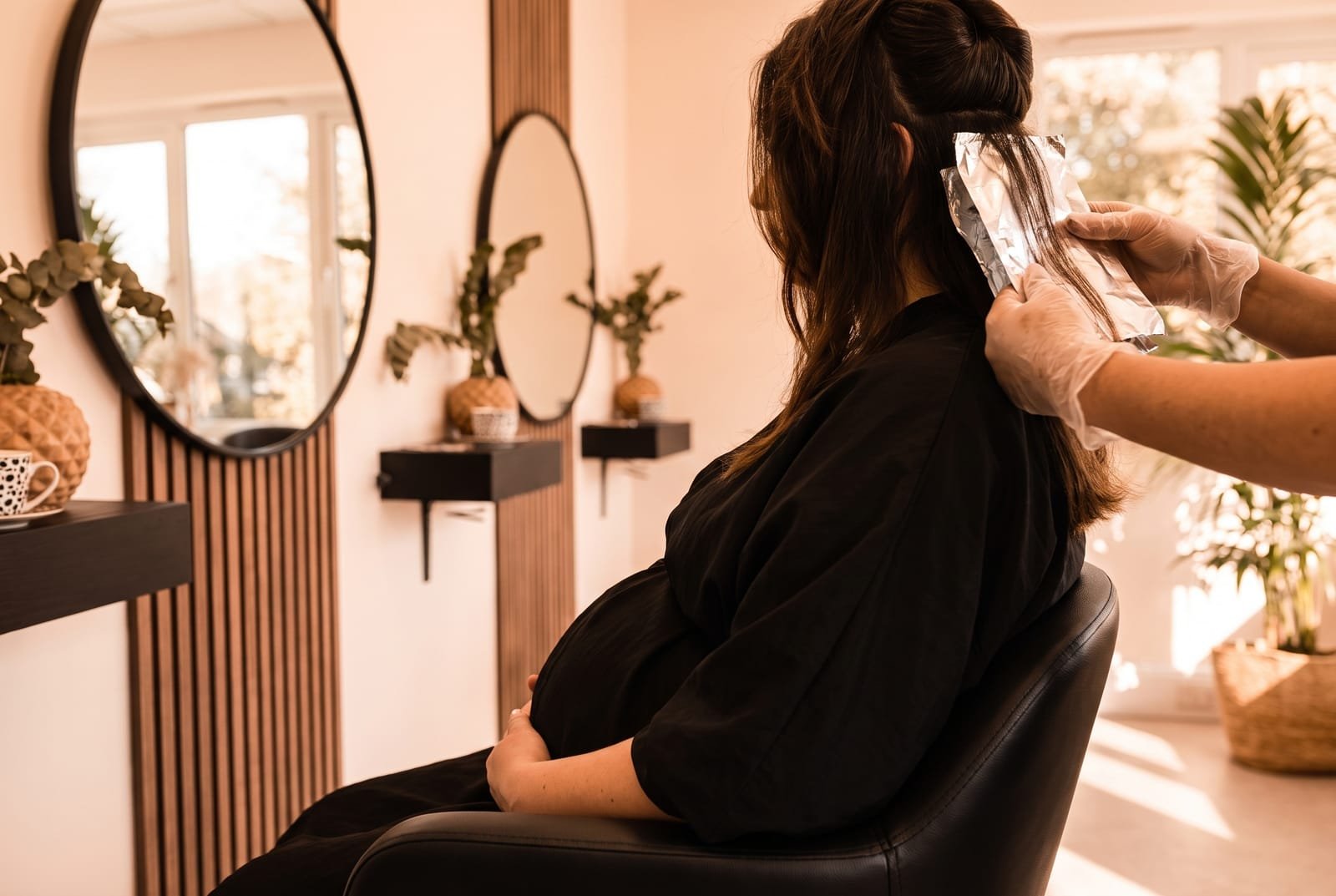
Say a client comes in at nine weeks pregnant, a regular who normally has a full head of colour every six weeks, and is not sure what to do. Rather than turning her away or dyeing her hair exactly as usual, the conversation goes somewhere more useful. We would talk through foils instead of a full-scalp application: foils keep the dye on the hair strand itself and off the scalp entirely, which both NHS and ACOG independently point to as the lower-exposure professional option, and it still gives a genuinely bright, noticeable result. We would also re-do her patch test, even though she has had the exact same colour before with no reaction, because pregnancy hormones can change how skin responds to something it has previously tolerated without issue. The room stays well ventilated, the dye is left on for the minimum time the product needs, and her scalp is rinsed thoroughly afterwards.
She leaves with brighter hair, no scalp saturation, and a plan to come back for a root melt rather than a full re-colour until she is further along, if that is what she is comfortable with. Nobody is turned away, and nothing is done without talking it through first.
Who this isn’t for, and when we would say wait
If you have ever had an allergic reaction to hair dye before, even a mild one, that is the one situation where we would push harder on caution, pregnant or not. There is a documented case in BMJ Case Reports of a woman at 26 weeks pregnant who developed severe facial swelling three days after a routine colour appointment, despite having used the same dye without any problem previously; patch testing afterwards confirmed a genuine allergy to PPD. She recovered within 24 hours with treatment, and the authors published the case specifically to raise awareness that pregnancy can change your skin’s reaction to something it has handled fine before. That is precisely why we insist on a fresh patch test every time for a pregnant client, whatever your history with a colour.
We would also say wait, or steer firmly toward foils, if you are in the first trimester and would simply feel more at ease avoiding full-scalp chemical contact until you are past it. That is not us being overcautious. It is the same precautionary window NHS, ACOG and the American Pregnancy Association all independently recommend.
Real henna is never black. If a "black henna" tattoo is on offer, that darkness is almost always unregulated PPD, and it is the one genuine skin-allergy risk in this whole topic worth taking seriously.
The full, honest option set
There is more than one way to handle colour during pregnancy, including a couple of routes we do not offer ourselves. Here is the full picture of all of them, weighed plainly.
| Option | Scalp contact | Verdict |
|---|---|---|
| Full permanent colour | Direct, full-scalp | The most complete colour change; many choose to wait until after week 13 out of the general precaution above |
| Highlights, balayage or foils | None, dye stays on the hair strand | The lowest-exposure professional option NHS and ACOG both point to; can’t fully change your base shade |
| Semi-permanent, ammonia-free colour | Some, but no ammonia and usually lower peroxide | Gentler fumes and shorter contact time, at the cost of colour fading faster |
| Real henna (plant-based) | Yes, but not the same chemical class as oxidative dye | NHS-listed as a safer alternative; limited to reds and browns, and “black henna” is a different, risky product (see below) |
| At-home box dye | Full scalp, unsupervised | No professional patch test, no controlled ventilation and no colourist judging timing, the exact controls the safety advice above assumes are in place |
| Root touch-up only | Minimal, targeted | The lowest-exposure way to address regrowth without a full re-colour |
| Wait until after the birth | None | Zero exposure and zero anxiety; a genuinely valid personal choice, not a medical requirement |
Nowhere on that list is “wrong.” NHS, ACOG and the American Pregnancy Association each frame this as your decision to make, not a rule to follow, because the underlying evidence is reassuring rather than a guaranteed all-clear. Large, rigorous human trials specifically testing hair dye in pregnancy do not exist, for the obvious ethical reason that nobody sets out to deliberately expose pregnant women to test a chemical’s safety. What we do have is decades of occupational and mechanistic evidence pointing the same direction: minimal absorption through healthy skin, no controlled trial linking normal personal use to birth defects, and a genuine but separate allergy risk that a patch test is specifically designed to catch.
Other treatments people ask about during pregnancy
A version of the same question comes up across most of what we do, so here is the short, plain answer for each.
Gel manicures and BIAB. Generally considered low-risk with decent salon ventilation. The specific thing to watch is acetone exposure during removal, so a salon with proper air extraction and a sensible soak time matters more than the polish itself.
Massage. NHS’s detailed guidance covers perineal massage from 35 weeks rather than general body massage earlier on, so there is no specific NHS ruling here; it is common UK therapist practice to wait until after week 13 as the same kind of precaution as hair dye, and to avoid deep pressure on the wrists and ankles, an old belief with little evidence behind it that most therapists still avoid as standard caution. If a firm massage is what you’re after, our sports massage vs deep tissue massage guide explains why we’d point you to a dedicated pregnancy massage instead of either of those.
Spray tans and fake tan. NHS confirms fake tan creams and lotions are “generally considered safe,” since the active ingredient, DHA, “isn’t thought to go beyond the outer layer of skin.” Spray tans specifically are the one to be more cautious with, because the effects of inhaling the fine mist during application are not well studied, so a cream or lotion application is the safer-to-recommend format.
Waxing. No evidence links waxing itself to any pregnancy risk. The genuine pregnancy-specific point is that hormonal changes can make skin more reactive than usual, so a patch test on a small area first, and a gentler wax where sensitivity is a concern, is sensible.
If any of those are on your mind alongside your hair, our pregnancy treatments page covers what we offer and how we adapt each one.
The bottom line
Colouring your hair while pregnant is, on the evidence we could find, generally fine, and the caution you see repeated everywhere is mostly about timing and technique rather than the dye itself being dangerous. Foils and balayage keep chemicals off your scalp and are the lower-exposure route if you want colour early on. A fresh patch test every time is the one non-negotiable, because pregnancy can change how your skin reacts even to a dye you have used for years without issue. And if you would simply rather wait until after the birth, that is not the anxious choice, it is just a different, equally valid one.
Every new colour at our Haverhill studio starts with a free consultation, so tell us if you are pregnant when you book and we will talk through foils against a full head, current pricing (a global head colour is currently £62.99, a full head of highlights £101.99, and a new balayage £119.50), and re-do your patch test properly rather than skipping it because you have been a client for years. If you are weighing up balayage against highlights generally, our balayage vs highlights guide is worth a read before you book either.
Frequently asked questions
Is there a specific trimester I should avoid dyeing my hair?
Most guidance points to the first trimester, but it is a precaution rather than proof of harm. NHS, the American College of Obstetricians and Gynecologists and the American Pregnancy Association all suggest waiting until after week 12 to 13, timed to when a baby's major organs are forming and miscarriage risk from any cause is naturally highest, not because a study has shown hair dye itself causes harm in that window. After the first trimester, most sources are comfortable with an occasional colour.
Can I get highlights or balayage early in pregnancy?
This is usually the safer swap if you want colour before 12 weeks. NHS and ACOG both make the same point independently: foils and balayage keep dye off your scalp entirely, since only the hair strand is coloured, so there is far less chemical contact with your skin than a full head of colour. A root touch-up alone is even lower contact again.
Will a hairdresser refuse to dye my hair if I am pregnant?
A responsible salon will not refuse outright, but should ask more questions than usual. Expect us to re-do your patch test even if you have used the same colour before without any reaction, recommend foils over full-scalp colour in the first trimester, and make sure the room is well ventilated. None of that is us being overly cautious for the sake of it; it is standard NHS advice for anyone colouring their hair during pregnancy.
Is henna safe to use during pregnancy?
Real, plant-based henna is listed by the NHS as a safer alternative, but only the real thing. What is sold as 'black henna', often at holiday resorts as a temporary tattoo, is a different and genuinely risky product: it is usually real henna with a high, unregulated dose of PPD added to darken it fast, which is illegal for skin contact in the UK and EU and can cause severe blistering burns and long-term allergy. Genuine henna, which is reddish-brown and never truly black, does not carry that risk.
Can I dye my hair while breastfeeding?
Yes. The same evidence that shows very limited absorption through the scalp during pregnancy applies here too, and none of the authorities we researched for this guide flag breastfeeding as a reason to avoid salon hair colour. If you are especially cautious, the same foils-over-full-colour logic still applies.
What happens if you accidentally dye your hair without knowing you were pregnant?
Try not to worry. The evidence is genuinely reassuring: a peer-reviewed review in Canadian Family Physician found occupational hair-dye exposure, in colourists doing six colour applications a day, resulted in plasma levels below the limit of detection. A single personal colour appointment is a far smaller, one-off exposure than that. Mention it to your midwife at your next appointment so it is on your notes, but there is no evidence this on its own causes harm.