The short answer
Four different things get called strawberry legs, and they need four different answers. If yours are down to shaving, waxing genuinely helps. If they are keratosis pilaris, no hair removal will touch them.
Strawberry legs is the nickname for the small dark dots or open-looking pores that appear on the legs, most often after shaving, dotted over the skin a bit like the seeds on a strawberry. It is not a medical diagnosis, and that is the important part: at least four completely different things produce that look.
Which matters more than any product recommendation, because the fix for one of them is useless for another, and one of them is not fixable at all. So before you buy another scrub, work out which one you are actually dealing with.
What causes strawberry legs? Work out which one you have
Have a proper look at your legs in daylight, and feel them. What follows is the single most useful thing on this page.
| What you can see and feel | What it probably is | What actually helps |
|---|---|---|
| Dark dots, skin smooth between them, worse right after shaving | Clogged follicles, or the blunt end of a shaved hair showing through | Change how you remove the hair |
| Rough like fine sandpaper, small bumps, also on upper arms or thighs | Keratosis pilaris | Moisturiser and acids, patiently. Hair removal does nothing |
| Red, sore or itchy bumps, sometimes with a whitehead | Folliculitis or ingrown hairs | Stop hair removal for a bit, do not pick |
| Flat brown marks where a spot or ingrown used to be | Pigment left behind by old inflammation | Time and sun protection, not scrubbing |
Most people have a mix of two. That is normal, and it is also why the generic advice to just exfoliate more gets people nowhere.
Why the dots are dark, and why scrubbing harder fails
Two separate things make a dot look dark, and only one is still sitting in the pore.
The first is trapped debris. A follicle holds oil, dead skin and a little bacteria, and the top of that plug oxidises where it meets the air, so it darkens. Same process as a blackhead on your face, just on your legs. Exfoliation genuinely helps this one.
The second is pigment, and almost every guide skips it. When a shaved hair curls back into the skin it triggers what dermatologists call a foreign body inflammatory reaction, and once that settles it can leave post-inflammatory hyperpigmentation behind (DermNet, updated February 2022). Those dots are not plugs any more. They are stains from an old injury, with nothing left in the pore to scrub out.
Which is why people exfoliate religiously for a month and see no change. They were never scrubbing at the right thing, and all the scrubbing did was irritate skin that was already inflamed.
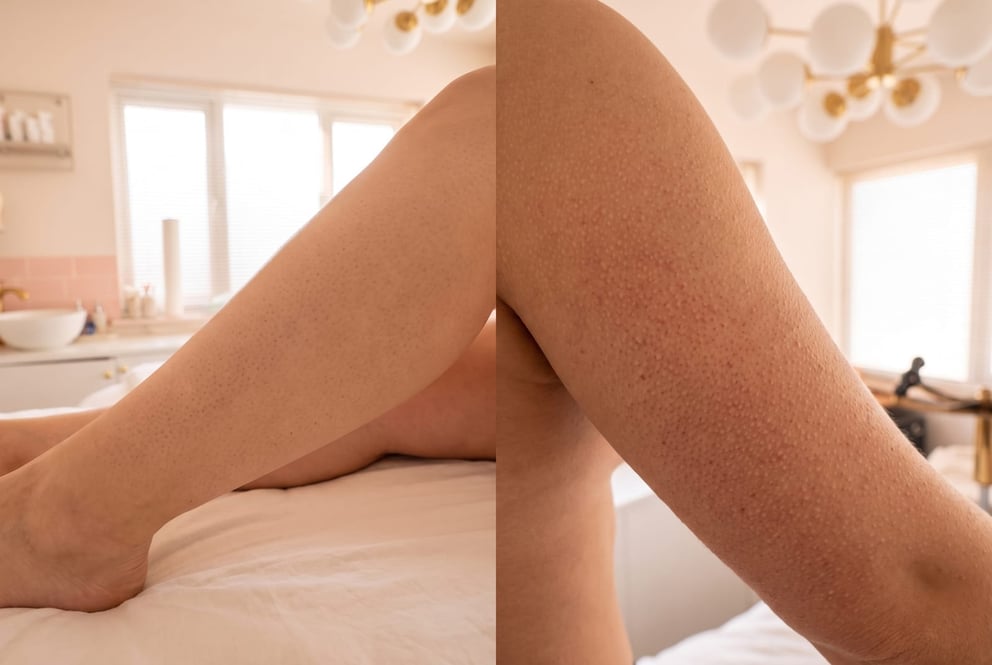
The difference is easier to feel than to see. Run a hand over it: speckled but smooth is the shaving kind, rough like fine sandpaper is keratosis pilaris.
Does waxing get rid of strawberry legs?
Straight answers to this are oddly hard to find, probably because most of the pages ranking for it are written by companies that sell razors or creams. We sell waxing, so read the following knowing that, and note we are about to tell you it will not touch two of the four causes.
Where it genuinely helps. If your dots are shaved hair showing through the follicle, taking the hair out at the root removes the thing you were looking at. There is no blunt cross-section under the surface any more. You also get three or four weeks without a blade on skin that was being irritated every other day. Root removal is exactly why epilators get recommended for this by Healthline and by Dr Ross Perry at Cosmedics; a wax does the same job with someone else holding the strip.
Where it does nothing. Keratosis pilaris is a plug of keratin, not a hair. You could wax those legs for a year and the bumps would be exactly where you left them.
Where it can make things worse. The NHS lists waxing, plucking and threading among the causes of ingrown hairs (NHS), and DermNet attributes irritant folliculitis to regrowth after shaving, waxing, electrolysis or plucking (DermNet). So if ingrowns are already your main problem, swapping a razor for wax is not automatically an upgrade. It often becomes one as regrowth softens over a few regular appointments, but it is not a guarantee, and you should know that before you book. If ingrown hairs, not speckling, are your actual complaint, our guide to how to get rid of ingrown hairs covers home treatment and prevention in full.
What four weeks off the razor actually changed
A client came in before a holiday in June, fed up. Shaving every other day for years, three different scrubs tried, and the dark speckling across her shins was the thing she disliked most about her legs.
We looked properly first. Her shins were the smooth-between-the-dots kind, so shaving was the culprit there. But she also had fine rough bumps on the backs of her upper arms, which is keratosis pilaris and was never going to respond to a wax. We told her that before she booked anything.
She had a full leg wax and came back four weeks later. Her shins did look noticeably clearer, with no stubble sitting under the skin and a month of not irritating the area. Regrowth came through finer and patchier, which is normal by the second or third wax. A few brown marks low on her shins had not shifted at all, because those were old pigment, and pigment does not care what you do to the hair. Her arms were unchanged, exactly as we had said, and she uses a urea cream on those now.
Better, not perfect, and better only where it was ever going to be.
When waxing is not the answer
Some legs should not be waxed at all, and some do not need it.
That last one deserves more, because it is so common. Keratosis pilaris affects between 50 and 70 percent of teenagers and around 40 percent of adults, runs in families, and cannot be cured (British Association of Dermatologists, updated November 2021). The NHS calls it harmless, notes it usually improves in summer and worsens in winter, and says it often clears up on its own eventually (NHS, last reviewed July 2024). What helps is unglamorous: moisturise properly, use creams containing salicylic acid, lactic acid or urea, wash with something mild and unperfumed, keep showers cool, and do not scrub at it.
How to get rid of strawberry legs: everything else worth trying
Two we do not sell, mentioned because they are genuinely right for some people. A home epilator does the same root removal as a wax, cheaply, if you do not mind the discomfort. Laser hair removal is the most durable route if shaving really is your problem. Read the NHS first: it works best on pale skin with dark hair, is less effective on tanned skin or sun-bleached hair, needs sessions every six to eight weeks for body hair, and carries no guarantee every hair will go (NHS).
And see your GP, not a salon, if an area is very painful, hot or swollen, or you have a fever with it. That is an infection.
How long will it actually take?
Weeks for the texture, months for the colour. If you take one thing from this page, take that.
The rough, bumpy feel shifts relatively quickly, and four to six weeks is when dermatologists suggest reviewing whether a routine is doing anything (American Academy of Dermatology). Marks are far slower: the AAD says a spot a few shades darker than your natural skin tone usually fades within six to twelve months, and deeper discolouration can take years (AAD). Their real point is to treat the cause first, because once you stop inflaming the skin, the marks fade on their own.
The bottom line
Work out which kind you have before you spend anything. Smooth between the dots and worse after shaving? Changing how you remove the hair is the highest-value thing you can do. Rough like sandpaper, and on your arms too? Keratosis pilaris, and a urea cream will serve you better than we can. Flat and brown? Old pigment, and only time and sun protection shift those.
We wax legs at our Haverhill salon with warm Lycon wax, currently £34 for a full leg and £24.50 for a half leg, and a full body scrub is £33 if you would rather someone else did the exfoliating. Leg and body waxing is Haverhill only; our Kedington studio does brows, lip and chin waxing alongside nails, brows and lashes. New to waxing? Our guide to the difference between a Brazilian and a Hollywood covers how an appointment actually goes.
And if you show us your legs and we think a wax will not help, we will say so. That is a better use of your money than a treatment that was never going to work.
Frequently asked questions
What causes strawberry legs?
Four different things, which is why one fix does not work for everyone. The first is clogged pores, where oil, dead skin and bacteria sit in an open follicle and darken on contact with the air, much like a blackhead. The second is the blunt end of a shaved hair sitting just below the surface, dark and visible through the skin. The third is folliculitis or ingrown hairs, where the follicle becomes inflamed and can leave a lasting dark mark behind. The fourth is keratosis pilaris, a genetic condition where plugs of keratin block the follicles, and that one is not caused by hair removal at all. Working out which you have matters more than any product, because the answers are completely different.
Do strawberry legs go away after waxing?
It depends entirely on the cause, and no honest salon will promise you it will. If your dots are shaved hair showing through the follicle, or pores that clog up because you are dragging a blade over them every couple of days, then waxing does help, because it takes the hair out at the root and gives your skin three to four weeks without a razor on it. If they are keratosis pilaris, waxing will change nothing, because the plug is keratin rather than hair. And waxing is not risk free either: the NHS notes that waxing, plucking and threading can all cause ingrown hairs, which is one of the things you may be trying to get rid of in the first place.
How long does it take for strawberry legs to fade?
Weeks for the texture, months for the colour. The rough, bumpy feel can settle within four to six weeks of a consistent routine, which is roughly when dermatologists suggest reviewing whether an approach is working. The dark marks take much longer, because a lot of what you are looking at is pigment left behind by past inflammation rather than anything still sitting in the pore. The American Academy of Dermatology says a spot a few shades darker than your natural skin tone usually fades within six to twelve months, and deeper discolouration can take years. Anyone promising you clear legs in a week is selling something.
Are strawberry legs the same as keratosis pilaris?
Not quite. Keratosis pilaris is one of the causes of the strawberry legs look, but it is a specific, diagnosable condition, and strawberry legs is just a nickname for the appearance. The giveaway is texture and location. Keratosis pilaris feels rough, like fine sandpaper, and usually turns up on the upper arms and thighs as well as the lower legs, whereas shaving-related dots are on the legs alone and the skin between them feels smooth. It is extremely common, affecting somewhere between 50 and 70 percent of teenagers and around 40 percent of adults according to the British Association of Dermatologists, and it tends to be worse in winter.
Can you get rid of strawberry legs permanently?
Honestly, it depends which cause you have, and for some people the answer is no. If it is down to shaving, then changing how you remove hair can genuinely keep it away for as long as you keep that up. If it is keratosis pilaris, it cannot be cured. The British Association of Dermatologists is clear on that, though it does often clear up on its own during adult life. What you can do in every case is manage it well, and the pigment left over from old inflammation does fade in time once you stop irritating the skin.
Does laser hair removal get rid of strawberry legs?
It can help with the causes related to hair, and it is the most durable option if shaving is genuinely the problem for you. We do not offer laser at NU Beauty, so we have no reason to talk it up or down. Worth knowing before you book it anywhere: the NHS says it works best on pale skin with dark hair, is less effective on tanned skin or sun-bleached hair, needs repeat sessions every six to eight weeks for body hair, and comes with no guarantee that every hair will go. It also will not touch keratosis pilaris, since that is not a hair problem.