The short answer
Hair extensions are lengths of hair clipped, taped, bonded or sewn onto your own. Salon-fitted methods need a revisit every six to eight weeks, but the hair itself lasts up to a year with the right method for your hair.
Hair extensions are lengths of real or synthetic hair added to your own, either clipped on and taken off yourself or fitted at the salon with tape, tiny rings, a bonded strand or a sewn-in weft. How long they last is not one number: it depends entirely on which method you choose. Tape-in and sew-in weaves typically need a salon revisit every six to eight weeks, micro-ring and nano-ring extensions stretch to around twelve weeks, and fusion or keratin bond extensions go the longest between appointments at three to six months. Clip-ins are entirely in your own hands, since you put them in and take them out yourself, and the hair itself, if it is good quality and cared for properly, can usually be reused for up to a year either way.
- Tape-in: 6 to 8 weeks between visits
- Micro-ring / nano-ring / I-tip: up to 12 weeks
- Fusion / keratin bond: 3 to 6 months
- Sew-in weave: 6 to 8 weeks
- Clip-in: entirely up to you, up to a year with light wear
What is a hair extension, and how does it actually attach?
Every method does the same job, adding length, volume or thickness, but they attach in genuinely different ways, and that difference is what drives everything else in this guide.
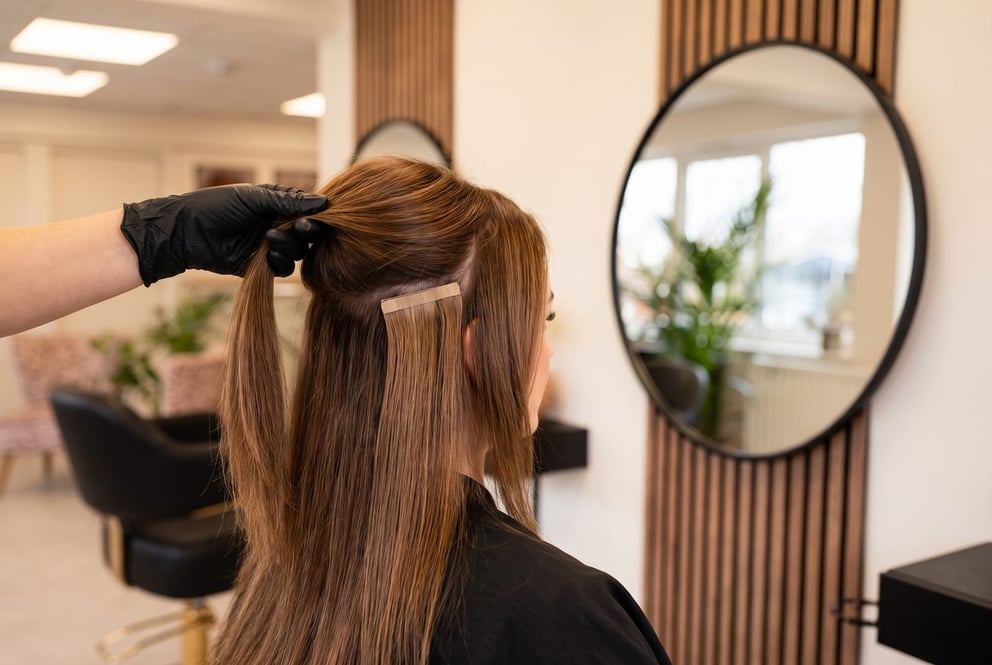
- Tape-in: wefts of hair sandwiched onto thin sections of your own hair with a strip of medical-grade adhesive tape.
- I-tip, nano-ring or micro-ring: individual strands clamped onto small sections of hair with a tiny metal or silicone ring, no heat or glue involved.
- Fusion or keratin bond: individual strands fused onto your natural hair with a small keratin bond, melted into place with a heated tool.
- Sew-in weave: wefts stitched onto cornrowed sections of your own hair, close to the scalp.
- Clip-in: temporary wefts with small clips, put in and taken out by you, day to day.
The first four are salon-fitted and semi-permanent. Clip-ins are the only one you manage entirely yourself, and NU Beauty’s Haverhill menu covers the salon-fitted end: tape, I-tip, nano and micro-bead, with a refitting and removal service alongside.
How long each method actually lasts
This is where most guides give you one vague number. Here is the real spread, by method, cross-checked across three independent UK and international hair extension retailers.
| Method | Between salon visits | Total lifespan of the hair |
|---|---|---|
| Tape-in | 6 to 8 weeks | Up to 6 months reused, longer on premium grade |
| Micro-ring / nano-ring / I-tip | Up to 12 weeks | Reusable after removal, quality-dependent |
| Fusion / keratin bond | 3 to 6 months | 3 to 6 months per application |
| Sew-in weave | 6 to 8 weeks | Varies; matting risk climbs sharply past 8 weeks |
| Clip-in, worn a couple of times a week | You control it | Up to a year |
| Clip-in, worn most days | You control it | 3 to 6 months |
The overlap across method write-ups is consistent enough to trust: tape and weave sit at 6 to 8 weeks, micro-ring stretches a little further, and fusion goes the longest between appointments. What none of them tell you is why the interval matters, which is the next section.
Cost follows the same pattern as lifespan: it depends on the method. UK salons commonly quote roughly £150 to £450 for tape-in hair plus £285 to £700 or more for the fitting, around £250 to £600 for micro-ring, and £350 to £700 for fusion or keratin bond, with maintenance visits typically £70 to £150 each (Airtasker UK, Perfect Locks, 2026). At NU Beauty’s Haverhill salon, tape hair extensions are currently £75 and I-tip, nano or micro-bead extensions are £150, both on our Haverhill hair extensions menu, and every fitting starts with a free consultation so you get an exact figure for your hair, not a national average.
The interval is not the salon being cautious. It is roughly how long it takes your natural hair to grow far enough for the attachment point to start pulling at an angle it was not fitted for.
A first-timer’s first eight weeks: what actually happens
Say you come in to our Haverhill salon for tape-ins for the first time, wanting length for a wedding six weeks out. At the consultation, we look at your hair’s thickness and condition and match a shade before anything is fitted, because tape sits flush against a wide section rather than gripping single strands, which makes it the gentler starting point for a first-timer. On fitting day, the wefts go in close to the root, and for the first 24 to 48 hours you keep them dry and avoid tying them up tightly.
Over the next six weeks your natural hair grows roughly half a centimetre, which is enough to start shifting the tape’s position away from the scalp. By week six or seven you will feel it: slightly more visible at the root, the odd bit of movement when you brush. That is not a fault, it is exactly what is meant to happen, and it is why you come back in around week six to eight for a reposition rather than waiting for it to become uncomfortable. If the hair is still in good condition at that point, the same wefts often go straight back in, re-taped, which is considerably cheaper than a full new set.
The safety talk no one else gives you
Most extension guides stop at “wash gently and use a heat protectant.” There is a real, medically recognised risk worth knowing about before you commit to any bonded or woven method: traction alopecia, hair loss caused by sustained pulling on the hair. The British Association of Dermatologists lists the attachment of weaves and hair extensions explicitly as a cause, alongside tight ponytails, buns and braids. The British Skin Foundation and the American Academy of Dermatology both independently name the same risk and give the same warning signs: itching, soreness, scalp flaking, or a “fringe” of longer hairs left around a thinning patch.
Sew-in weaves, fusion and micro-ring methods carry the most tension risk because they grip hair tightly at a fixed point. Tape-ins spread the load across a wider section, and clip-ins carry the least risk of all simply because they come out every day. None of this means extensions are unsafe when they are fitted and maintained properly. It means the maintenance interval in the table above is a health interval, not just a cosmetic one, and skipping it is the actual mistake, not the extensions themselves.
Who this isn’t for
If your hair is fine, fragile or already thinning, some methods genuinely are not the right call. Fusion, micro-ring and heavier bonded methods put real, concentrated tension on individual strands, which is a poor match for hair that cannot support the extra weight. Tape-ins tend to be the better-tolerated starting point for finer hair, because the load spreads across a wider section rather than pulling on single strands.
If you are recovering from a recent chemical service, have an active scalp condition, or your natural hair is very short, that is also worth flagging at the consultation rather than after the fitting. None of this is a hard no. It is a reason to have the honest conversation first, which is exactly what a free consultation is for.
The full picture: at-home clip-ins vs salon-fitted extensions
There is more than one honest route here, and not all of them involve booking anything.
- Clip-in wefts (at-home, no salon needed): put in and taken out yourself, lowest tension risk because nothing sits in your hair overnight, and the cheapest way to try the look before committing to anything semi-permanent. Not on NU Beauty’s salon menu, and genuinely fine as a standalone choice.
- Tape-in (salon-fitted): the gentler semi-permanent option, good starting point for first-timers and finer hair.
- I-tip, nano-ring or micro-ring (salon-fitted): individual strands, natural movement, a longer interval between visits than tape, but more tension per strand.
- Fusion or keratin bond (salon-fitted): the longest-lasting between appointments, fitted with heat, best suited to hair that can tolerate that level of tension.
- Sew-in weave: not currently on NU Beauty’s Haverhill menu, and worth knowing that it carries a higher matting and tension risk than the others if left in past its interval.
- Synthetic hair: cheaper up front but cannot be heat-styled and lasts roughly a third as long as human hair, so it is rarely the better-value choice once you count how often you would replace it.
There is no universally “best” option here, only the one that suits your hair, your budget and how much upkeep you actually want to commit to.
Hair extensions at NU Beauty in Haverhill
Our hair extensions menu sits alongside the rest of our hair studio’s services at our Haverhill salon: tape, I-tip, nano and micro-bead, plus refitting and removal, all starting with a consultation (currently £0, so there is no cost just to talk it through). If you are already planning a bigger hair change, extensions pair well with a fresh balayage or set of highlights booked once the new length has settled in, so the colour sits on hair you are keeping for a while.
The bottom line
Ignore anyone who gives you one number for how long hair extensions last, because the honest answer always depends on the method. Tape and weaves need you back every six to eight weeks, micro-ring stretches a little further, fusion goes the longest between visits, and clip-ins are entirely in your own hands. The hair itself, looked after properly, is good for up to a year either way. The bigger question is not how long extensions last, but whether the method you are drawn to actually suits your hair, and that is a conversation worth having before anything gets fitted, not after.
Frequently asked questions
Do hair extensions damage your hair?
They can, but they do not have to. The real risk is traction alopecia, hair loss caused by constant pulling, which the British Association of Dermatologists names hair extensions and weaves as a recognised cause of. Fitted correctly, refitted on schedule and not left in too long, extensions should not damage healthy hair. The warning signs are pain, headaches, or persistent redness and itching at the attachment points, and if you notice any of those, take them out and get it looked at rather than waiting it out.
How much do hair extensions cost in the UK?
It depends heavily on the method and how much hair you need. UK salons commonly quote roughly £150 to £450 for tape-in hair plus £285 to £700 or more for the full fitting, around £250 to £600 for micro-ring, and £350 to £700 for fusion or keratin bond, with maintenance visits typically £70 to £150 each. NU Beauty's own tape and I-tip, nano or micro-bead prices are on our Haverhill hair extensions menu, and every fitting starts with a free consultation first so there are no surprises.
Can I wash my hair normally with extensions in?
Mostly, yes, but gently. Use a sulphate-free shampoo and conditioner, apply it from the mid-lengths down rather than scrubbing at the roots or attachment points, and skip oil-based products near tapes or bonds, since oil is exactly what breaks the adhesive down early. Brush before you wash, brush again once dry, and always work from the ends upward so you are not dragging tangles into the bonds themselves.
Which type of hair extensions lasts the longest?
Clip-ins last the longest in total, because they come out every time you take them off rather than sitting in your hair full time. Worn a couple of times a week, a good set can last up to a year. Among the salon-fitted, semi-permanent methods, fusion or keratin bond extensions go longest between appointments at three to six months, while tape-ins and micro-rings need revisiting every six to twelve weeks. The hair itself, if it is good quality and looked after, can usually be reused across two or three fitting cycles either way.
Are hair extensions suitable for fine or thin hair?
Some methods, not all. Heavier bonded, micro-ring and fusion methods put real tension on individual strands, which is a bad match for fine or fragile hair. Tape-ins are the commonly recommended starting point because the weight is spread across a wider section rather than pulling on single strands. Whatever your hair type, this is exactly what a consultation is for, so we can look at your hair's density and condition before recommending a method, rather than fitting the same thing on everyone.
How often do hair extensions need maintaining?
Tape-ins and sew-in weaves typically need a salon revisit every six to eight weeks. Micro-ring, nano-ring and I-tip extensions can usually go a little longer, up to around twelve weeks, before they need repositioning. Fusion or keratin bond extensions go the longest between salon visits at three to six months. Whichever method you choose, do not skip the appointment: leaving any bonded method in well past its interval is when tangling, matting and tension on the scalp start to become a real problem rather than a cosmetic one.